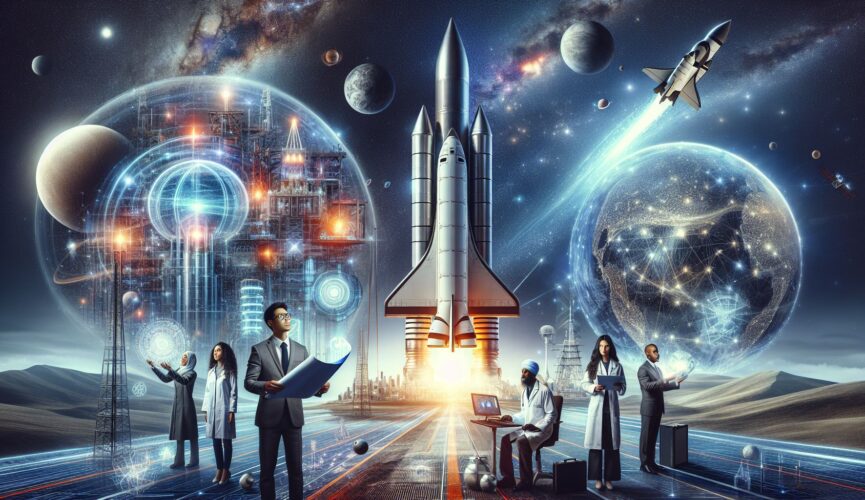
Let me start with a scene straight out of my daydreams: launching into the cosmos in a spacecraft without worrying that my lunch packet might boil over or that I forgot my spork. Clean, renewable energy—some sci-fi think-tank out there calls it “thruster dust.” As someone obsessed with esoteric sci-fi openings, the unveiling of NASA’s Dynamic Wireless Energy Transfer shows just how close we are to living that dream. Yep, that mind-boggling moment ain’t far.
Okay, maybe I kind of made “thruster dust” up (fair warning: writing often blurs definitions between legit stuff and supreme wish fulfillment!) This is about emerging breakthroughs in ion propulsion or even those fantabulous dreams of harnessed dark matter. Strap in; we’ll cruise through what’s cooking in the workshop of space travel’s new era.
Ion Propulsion: The Jetsons’ Jetstream Doesn’t Seem That Far Anymore
Now, if you thought DeLorean time machines were a stretch, wait till you wrap your noggin around ion propulsion. This tech eliminates the obsession with fuel stops in pesky ether-gas stations since its consumption is astonishingly less. Ion engines use electricity to accelerate ions—basically stripping electrons from atoms and shooting them out the back at incredible speeds. The thrust is gentle but constant, like having a tiny invisible hand pushing your spacecraft forward for months at a time.
NASA’s Dawn mission already proved this works. It visited two asteroids using ion propulsion, something that would’ve been impossible with traditional rockets. The fuel efficiency is mind-blowing—we’re talking about using a few pounds of xenon gas to travel millions of miles. Compare that to the massive fuel tanks needed for chemical rockets, and you start to see why this changes everything.
Nuclear Fusion: The Holy Grail Gets Real
Here’s where things get really wild. Fusion rockets could cut travel time to Mars from nine months down to just a few weeks. We’re talking about the same process that powers the sun, contained in an engine small enough to fit on a spacecraft.
The challenge has always been creating more energy than you put in. But recent breakthroughs in magnetic confinement and laser fusion have me genuinely excited. Companies like Helion Energy and Commonwealth Fusion Systems are making progress that seemed impossible just five years ago. Once we crack controlled fusion, space travel transforms from an endurance test into a quick hop between worlds.
The Dark Horse: Antimatter Propulsion
This is where we venture into truly exotic territory. Antimatter annihilation releases more energy per gram than any other known reaction—about 10 billion times more efficient than chemical rockets. A few grams could power a spacecraft to the nearest star.
The catch? Making antimatter requires enormous amounts of energy, and storing it without letting it touch regular matter (which would cause instant annihilation) is incredibly complex. CERN produces tiny amounts for research, but we’re talking about individual particles. Still, the theoretical possibilities are staggering. Interstellar travel could become reality within a human lifetime.
What’s on the Cosmic Canvas?
Looking ahead, I think we’re on the verge of a transportation revolution that’ll make the jump from horses to cars look quaint. Ion drives are already working. Fusion is getting closer every year. Even antimatter, while still science fiction, has moved from impossible to merely incredibly difficult.
The real game-changer will be when these technologies become cheap enough for commercial use. Right now, launching anything into space costs thousands of dollars per pound. When fusion rockets or advanced ion drives bring that cost down to hundreds or even tens of dollars per pound, everything changes. Space tourism, asteroid mining, permanent colonies—suddenly it all becomes economically viable.