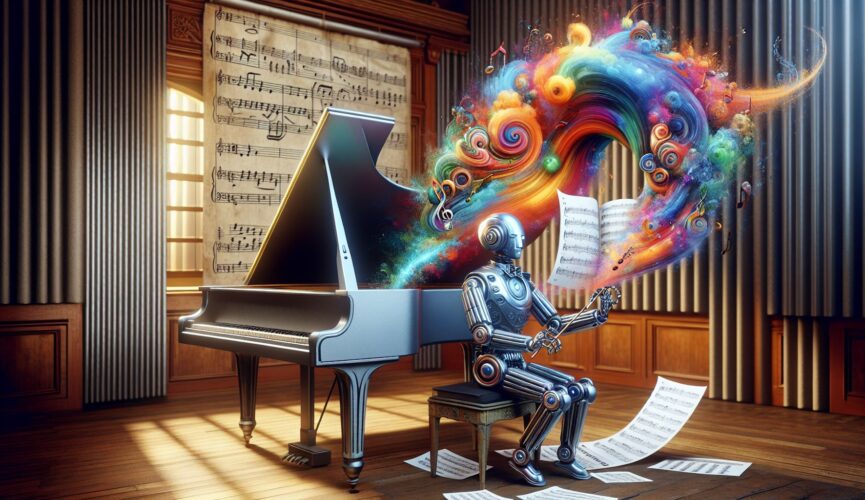
Hi tech friends! Grab your virtual popcorn because today we’re diving into something pretty wild happening where AI meets creativity. If your Spotify playlists are getting stale and you want something fresh, this one’s for you. We’re talking about machines making music and art that would probably make Mozart scratch his head in confusion. Ready for this ride?
Setting the Stage: AI’s Artistic Awakening
Honestly, I still can’t believe computers are making actual art now. Ten years ago, if you told me AI would create decent music or paintings, I would’ve laughed. The idea of algorithms composing symphonies sounded like sci-fi nonsense. But here we are, watching machines churn out melodies and digital masterpieces that actually don’t suck.
Companies like OpenAI (yeah, the ChatGPT people) have been pushing this forward hard. Deep learning systems are now swimming through musical harmony like they’ve been doing it for years. My laptop could theoretically start a record label at this point, which is both amazing and slightly terrifying.
Algorithms of Emotion or Just Clever Code?
Here’s what really gets me thinking: is this actual creativity or just really sophisticated copying? When I hear AI-generated music that gives me chills, is that genuine artistry or am I being fooled by clever programming?
AI basically works by pattern recognition on steroids. It’s like having a bee that’s studied every flower in existence and now knows exactly how to make honey. When you see those weird, beautiful images from AI art generators or hear an ethereal melody that sounds almost human, you start wondering: where’s the line between creation and imitation?
The debate gets pretty heated. You’ve got people saying AI can’t create “real” art because it lacks human experience and emotion. Then others argue that if the output moves you, does the source really matter? I’m honestly torn on this one.
Real-World Hits from Synthetic Sounds
What’s really interesting is seeing AI music actually make it onto streaming platforms. Some of these tracks are getting serious play counts, and most listeners have no idea they’re jamming to algorithm-generated beats.
I’ve found myself adding AI compositions to my own playlists. There’s something surreal about a computer nailing the exact mood I’m in, crafting melodies that hit just right. It makes me wonder if we’re witnessing the birth of a new kind of musical artist, one that doesn’t need sleep, inspiration, or creative blocks.
The quality has jumped dramatically in just the past couple of years. We’ve gone from robotic beeps to full orchestral pieces that could fool most people in a blind listening test.
AI on Canvas: Digital Brushstrokes
The visual art side is equally mind-bending. AI painting tools can now mimic famous artists’ styles or create entirely new aesthetic approaches. I’ve seen AI generate portraits that look like they took weeks to paint, all created in minutes.
What strikes me is how these systems understand composition, color theory, and visual balance without ever picking up a brush. They’ve absorbed thousands of artworks and somehow figured out what makes something visually appealing. It’s like having an art student who studied every museum in the world and can now paint in any style you want.
The results range from photorealistic to completely abstract, and some pieces genuinely stop you in your tracks. I’ve caught myself staring at AI artwork longer than I’d care to admit, trying to figure out how a machine captured something so emotionally resonant.
The Human Touch: Collaborators or Challengers?
The big question hanging over all this: are AI systems replacing human artists or creating new ways to collaborate? I think it’s more complicated than either extreme suggests.
Many artists are now using AI as a creative partner. They’ll generate initial concepts with AI, then build on them with human intuition and experience. Others see AI as a threat to their livelihood, and honestly, I get both perspectives.
What I find fascinating is how AI might be pushing human creativity in new directions. When machines can churn out technically perfect paintings or catchy melodies, human artists might focus more on conceptual depth, emotional authenticity, or interactive experiences that AI can’t replicate yet.
What Lies Ahead?
Looking forward, I think we’re just scratching the surface. AI creativity tools are getting more sophisticated and accessible every month. Soon, anyone might be able to create professional-quality music or art with just a few prompts.
The real wild card is where this leads us culturally. Will AI democratize creativity, letting anyone express complex ideas through art and music? Or will we drown in an ocean of algorithm-generated content? Probably both, knowing how technology tends to work out.
One thing’s for sure: the creative landscape is changing fast, and it’s going to be interesting to see how human and artificial creativity evolve together.