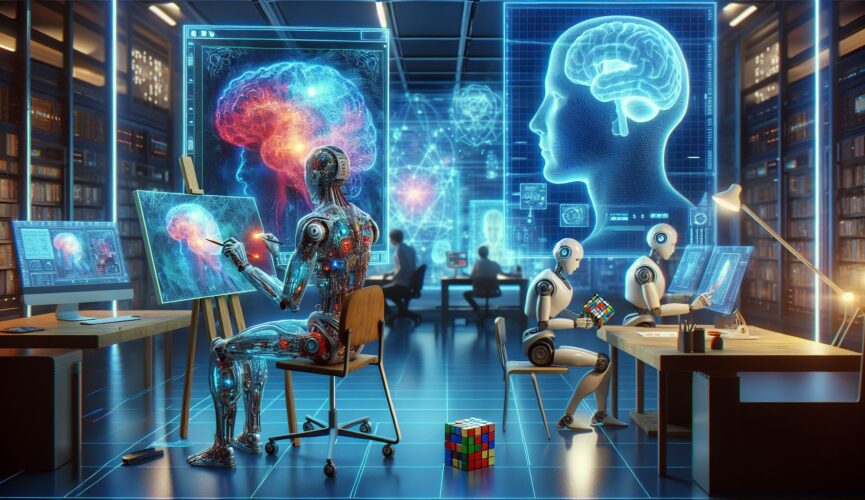
Hey tech aficionados! Today, let’s hop on an exhilarating ride, diving into the buzzing world where Artificial Intelligence ~whispers~ kind of harmonizes with the creative arts. Seriously, if someone had told me five years ago that machines would be generating bona fide artwork, I would’ve said, “Yeah, right—right after my coffee machine learns to also make my bed.” Humor me for a few paragraphs, and let’s explore how AI is painting, playing, composing, and scripting its way into realms once ruled to be oh-so-human. Grab your espresso (or drink of choice), and let’s do this!
Decoding machine-led creativity
When discussing AI and creativity, the elephant staring us down is “Can machines create ‘true’ art?” Well, that’s kind of like asking, “Can dogs do calculus?” Both imply traditional notions don’t quite fit. AI doesn’t sip chai under an olive tree and ‘rate’ humanity’s existential crisis on airbrushed parchment, sure, but it spits out surprisingly human-like creations thanks to algorithms cracking patterns faster than my typing between coffee slurps!
Consider Nvidia’s GauGAN2, for instance. Ever fancied being a pro landscape artist but lacked more artistic chops than an icing-sugar dusted cake? GauGAN2 lets users transform basic sketches into detailed artworks. I tested it four months back and honestly thought there had to be some kind of magic happening inside those processors.
Beyond images: Sound and words get the AI treatment
Giving visuals all the applause would be narrow-minded, kinda like Pokémon only showcasing Pikachu (though, pretty rad for Pikachu lovers). AI is also blurring boundaries in music and writing, commanding orchestras and breathing life into blank pages.
GPT-3 by OpenAI is our star player here. It writes dialogue and speeches with almost scary skill, like Shakespeare meets Aaron Sorkin (jokes and all). The thing handles subtle prompts and layers complexity into prose or scriptwriting that genuinely surprises me.
Then there’s Google’s algorithm that composes full symphonies. We’re talking about instruments that people once swore could never be automated. Hearing machines pull at heartstrings through music? That’s when you know we’ve hit something big.
The messy reality of AI art
Here’s where things get complicated. AI art isn’t just appearing in a vacuum. It’s learning from centuries of human creativity, gobbling up every artistic movement, every brush stroke, every color choice that came before. That raises some thorny questions about originality and ownership that honestly make my head spin.
I’ve seen AI recreate Van Gogh’s style so convincingly it’s unsettling. But is it creating or just remixing? The art world is still figuring this out, and frankly, so am I. Some days I’m amazed by what these systems produce. Other days I wonder if we’re losing something essentially human in the process.
The weird and wonderful unknown
What gets me most excited (and slightly terrified) is how unpredictable this all feels. We’re basically teaching machines to be creative, but we can’t always predict what they’ll create. It’s like giving a toddler finger paints and hoping for the best.
I’ve watched AI generate poetry that gave me chills and music that made me stop everything I was doing. But I’ve also seen it produce absolute nonsense that looks impressive until you really examine it. The technology is improving so fast that what seemed impossible last year is now my Tuesday afternoon.
What this means for actual humans
So where does this leave us creative humans? Are we all doomed to be replaced by algorithms? I don’t think so, but the landscape is definitely shifting under our feet.
What I’m seeing is AI becoming more like a really sophisticated tool than a replacement. Musicians are using it to break through creative blocks. Writers are experimenting with AI-generated ideas as springboards. Visual artists are incorporating AI elements into larger works. It’s collaboration more than competition, at least for now.