The Great Expectations Game
Meta’s Code Llama 3 dropped in late 2025 with all the fanfare of a product launch that promised to revolutionize how we write software. The marketing materials painted pictures of junior developers coding like seasoned architects and senior engineers finally freed from the mundane task of translating business requirements into executable logic. The reality, as anyone who’s actually tried to ship production code knows, is messier than the demos suggest.
The benchmark numbers look impressive at first glance. Code Llama 3 achieved a 78% accuracy rate on HumanEval, the standard coding benchmark that’s become the SAT score of AI code generation. But here’s where things get interesting: when researchers at Stanford tested it against actual enterprise codebases in their Stanford CodeGen Research Study, that accuracy plummeted to 34%. This isn’t a small gap. This is the difference between solving textbook problems and debugging a legacy payment system that processes millions of transactions while three different teams are simultaneously refactoring the authentication layer.
The disconnect between benchmark performance and real-world utility shows something important about the current state of AI code generation. These models excel at producing syntactically correct code for well-defined problems, but software development in the enterprise is rarely about writing perfect functions in isolation. It’s about understanding context, navigating technical debt, and making architectural decisions that won’t come back to haunt you during the next sprint planning meeting.
When Experience Trumps Automation
Perhaps the most telling signal comes from how experienced developers actually use these tools. GitHub’s 2025 Developer Experience Report revealed that Copilot usage among teams with five or more years of experience dropped by 23% after the initial six-month adoption period. This isn’t because seasoned developers resist new tools or get stuck in their ways. It’s because they recognize when a tool helps and when it creates more work.
The pattern becomes clearer when you look at what these experienced developers spend their time on instead. Stack Overflow’s 2025 survey found that 67% of developers now spend more time debugging AI-generated code than writing original solutions for complex business logic. This creates an interesting paradox where the tool designed to accelerate development actually introduces new friction points in the development process.
Consider the cognitive overhead involved in reviewing AI-generated code. A senior developer doesn’t just check whether the code compiles or passes basic tests. They evaluate whether it follows established patterns, handles edge cases appropriately, integrates cleanly with existing systems, and maintains the architectural principles that keep large codebases manageable. When AI generates code that looks correct but violates these principles, the review process becomes more complex than writing the code from scratch.
The Security Reality Check
Security represents perhaps the most critical gap in current AI code generation capabilities. Anthropic’s Claude 3.5 Sonnet, widely regarded as one of the more sophisticated models, showed a 45% false positive rate when suggesting security fixes in production environments during beta testing at twelve Fortune 500 companies. This isn’t just an academic concern. False positives in security tooling create alert fatigue and can mask real vulnerabilities in a sea of noise.
The challenge goes beyond mere accuracy. Security in software development requires understanding threat models, regulatory requirements, and the specific attack vectors relevant to a particular system. An AI model might suggest implementing rate limiting to prevent brute force attacks, but it can’t evaluate whether that rate limiting conflicts with legitimate high-frequency trading operations or whether it properly accounts for load balancer behavior in a multi-region deployment.
More concerning is the potential for AI-generated code to introduce subtle security vulnerabilities that pass initial review. A function that correctly implements its primary logic but fails to properly validate input parameters might work perfectly in testing environments while creating exploitable weaknesses in production. These are exactly the kinds of issues that experienced developers learn to catch through years of dealing with the consequences of similar oversights.
The Integration Tax
Microsoft’s internal DevOps metrics reveal another critical insight: GPT-4 Turbo code generation requires an average of 2.3 human review cycles before reaching deployment readiness. This number represents more than just iteration overhead. Each review cycle involves context switching, architectural evaluation, and often significant refactoring to align generated code with existing patterns and standards.
The integration challenges become exponentially more complex in large, distributed systems where code changes can have cascading effects across multiple services. AI models excel at generating isolated functions or small modules, but they struggle with understanding the broader system implications of their suggestions. A seemingly innocent optimization in a data processing pipeline might improve local performance while creating bottlenecks in downstream services or violating service level agreements with external partners.
Enterprise development also involves navigating constraints that rarely appear in training data. Compliance requirements, internal coding standards, performance budgets, and compatibility requirements create a complex web of considerations that influence every technical decision. An AI model might suggest using the latest language features for cleaner code, not knowing that the deployment environment is constrained to older runtime versions for regulatory reasons.
The Signal in the Speculation
Despite these limitations, the trajectory of AI-assisted development points toward some genuinely useful possibilities. The tools are getting better at understanding context, and the integration points are becoming more sophisticated. What we’re witnessing isn’t the failure of AI in software development, but rather the early stages of a technology finding its appropriate role in the development lifecycle.
The most promising applications seem to emerge when AI tools complement rather than replace human expertise. Code generation for boilerplate, automated test case creation, and documentation assistance represent areas where the technology already provides clear value. These use cases align AI capabilities with tasks that developers find tedious but that don’t require the deep contextual understanding that characterizes complex software development.
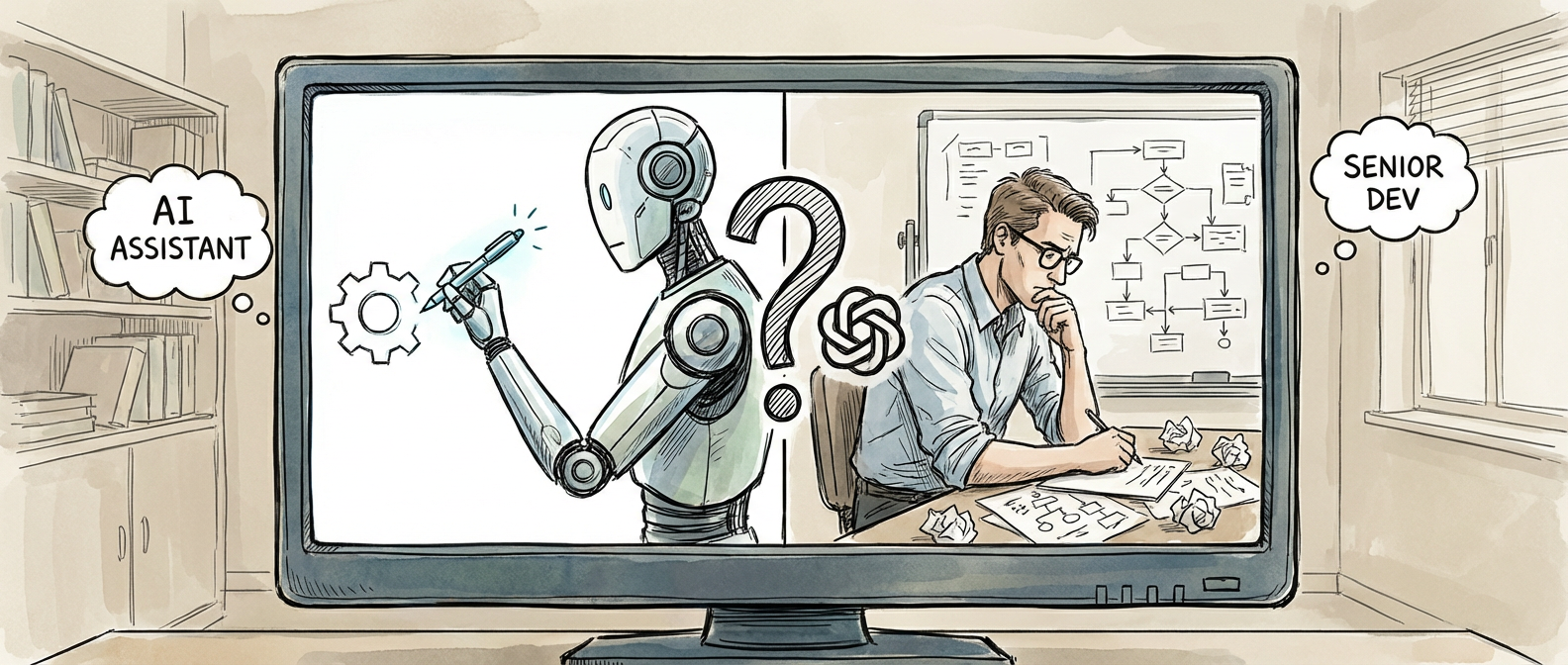
Looking ahead, the next breakthrough will likely come from AI systems that understand not just syntax and patterns, but also the broader organizational and technical context in which code operates. This means integrating with project management systems, understanding deployment pipelines, and learning from the accumulated wisdom embedded in code review comments and incident reports. Until then, your senior developers aren’t going anywhere. In fact, their ability to navigate the intersection between AI capabilities and real-world constraints makes them more valuable than ever.
What’s your experience been with AI code generation tools? Are you seeing similar patterns in your organization, or have you found ways to make these tools more effective for complex development work?