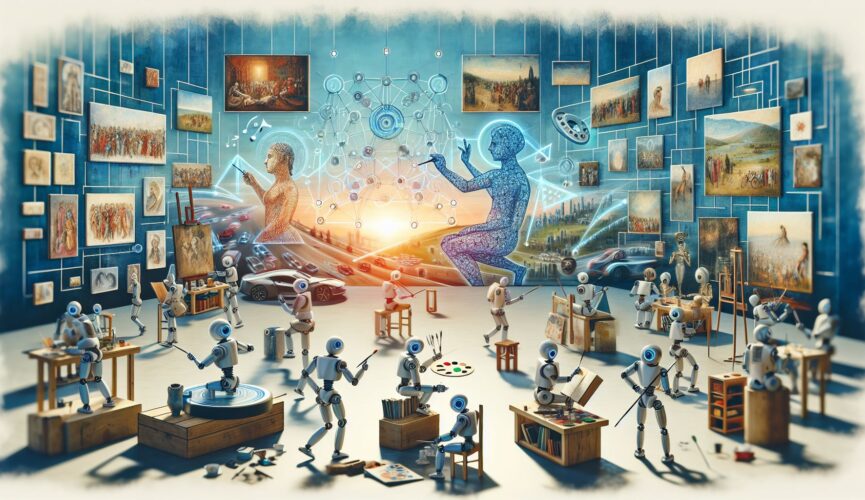
There are good days in the tech world, and then there are phenomenal days, the kind that make you pinch yourself just to be sure everything’s real. Today is one of those latter types. We’re witnessing an incredible breakthrough in Artificial Intelligence that has the potential to completely transform the creative arts forever. As an excited tech enthusiast, I’m beyond eager to dive into my digital soapbox and share every juicy detail with you.
AI’s foray into the creative arts is nothing less than a new renaissance. Our beloved algorithms aren’t just calculators anymore. They’re authors, composers, and painters! I mean, who would’ve thought that cold, calculative codes could play Mozart, canvas brush, or dare I say out-Hemmingway Hemingway? Buckle your seatbelts because the tour bus to the AI art gallery is about to leave!
Switching Brushes: Computers Meet Canvases
For anyone relegating computers to the cold realms of zeros and ones, it’s time to delight their eyes. Machines are breathing life into pixels like they’re the new Vincent van Gogh’s 2023 release. Paintings generated by AI models, known as GANs (Generative Adversarial Networks), can create distinctively unique pieces indistinguishable from those formed by the human hand.
Take for example “Edmond de Belamy,” an algorithmically-generated portrait auctioned by Christie’s. The sale generated unprecedented excitement and, not surprisingly, hefty investment. Among all the shocked eyebrows at seeing such works fetching top dollar, I’d bet Van Gogh would have nodded delightedly.
The team at DALL-E, OpenAI’s image generation system, has gone further by teaching AI to wear modern graphic artist hats. It generates anything from imaginary animals to abstract moods using simple text inputs. An AI Michelangelo tasked merely to craft “a colorful, overloaded penny-farthing wrought of belted gears like a Monet starry night as viewed by Bowie” might officially mark the start of art nouveau all over again!
AI Beyond Numbers: Poetry and Prose
Forget mathematicians poking through dusty arithmetic books alone in distant libraries. AI is headed for poetry contests next! Generative language models now construct written prose in surprisingly poetic styles. GPT and similar models, developed by researchers at organizations like OpenAI, throw around language like confetti to audiences hungry for more verbal artistry.
These aren’t just Twitter-bound pun machines full of witty one-liners. We’re talking about AI that can write in the style of Shakespeare, craft modern short stories, and even attempt novels. The quality varies wildly, sure. Sometimes you get beautiful, haunting passages that give you chills. Other times you get complete nonsense that reads like a fever dream.
I’ve spent hours feeding prompts to these systems, watching them spin tales and poems. It’s fascinating and a little unsettling. The best outputs make you forget a machine wrote them. The worst remind you that we’re still early in this journey. But even the failures are interesting failures, weird and wonderful in their own way.